Restrictions on literacy for women and girls
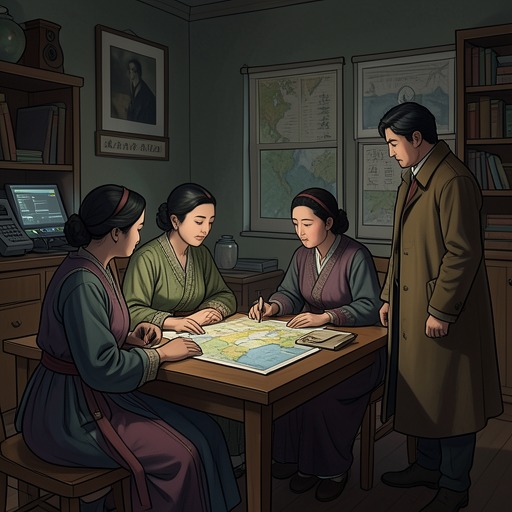
Women TalkingRestrictions on literacy for women and girls in Molotschna Colony limit more than access to books: they leave women dependent on male authorities to interpret the Bible and help define what obedience requires. The women’s discussion exposes how that dependence shapes their understanding of faith, violence, and the decision to leave, while their own reasoning begins to challenge the authority built upon it.
Literacy in daily life
The evidence presents restricted literacy as a condition of women’s lives, not as a clearly specified written law. Salome Friesen states that the women cannot read, and Ona Friesen identifies their inability to read or write as a serious disadvantage whenever biblical interpretation is negotiated. The restriction is not absolute in precisely the same way for every woman: Agata Friesen says that the women know how to write their names, though doing so takes her longer than planting a crop of canola. Greta Loewen jokes that it would also take longer than harvesting it. Mariche Loewen says she has not learned even to write her name because she has been too busy. Together, these details distinguish limited, uneven command of writing from the ability to read scripture independently.
The difference is consequential. A name that can be written only slowly, or not at all, is a narrow form of literacy; it does not give the women independent access to the text that is invoked to govern them. Their discussion makes this shortfall tangible rather than abstract: literacy is measured against the planting and harvesting that organize their work, and against the daily demands that leave little opportunity to learn.
Scripture mediated by male authority
When Mejal Loewen says the women have been told what is in the Bible, Salome identifies the source of that knowledge: Peters, the elders, and their husbands. Mejal acknowledges that these interpreters are men, but asks who else could interpret scripture for the women. Salome’s argument is that this arrangement makes it impossible for women to verify the claims on which their expected submission rests. If the only reason a wife believes the Bible requires her to submit is that her husband has told her so, the husband’s interpretation can pass as the Bible’s own command.
Salome tests that dependence by considering what would follow if a husband claimed that scripture authorized violence against his wife and children and required her to carry out the same discipline. The example is an argument about authority, not evidence that the women have independently read the relevant passages: without the means to check the text, a claim about divine instruction can be presented as unquestionable. Salome therefore distinguishes the Bible itself from the male interpretation handed down to the women. Ona supports the point directly, describing their inability to read and write as a major disadvantage in any negotiation over biblical meaning.
Knowledge, harm, and judgment
The literacy restriction sits within a wider struggle over who is permitted to define what has happened to the women. Since 2005, women and girls in Molotschna have been assaulted at night after being rendered unconscious with an animal anesthetic. Many in the colony had believed that the attacks were the work of ghosts or Satan and a punishment for sin; the perpetrators were eventually identified as eight men from the colony, including close relatives of women they attacked. The evidence does not make illiteracy the cause of that misbelief. It does, however, place the attacks alongside a social order in which authoritative explanations are supplied by others rather than tested through women’s independent access to knowledge.
Ona’s question about forgiveness shows the stakes of accepting such explanations. The elders and the bishop have decided that women do not require counseling because they were unconscious during the assaults. Ona asks what they are then obliged—or able—to forgive if they cannot understand what happened to them. Her challenge joins a demand for recognition to a larger question about the limits of knowledge: not knowing the world, she asks, does not make a person free of confinement. Restricted literacy is not presented as the only limit on what women can know, but it sharpens the distinction between what authorities tell them and what they can assess for themselves.
Women’s reasoning and the decision to leave
The women do not simply abandon religious argument when they dispute male interpretations. Agata Friesen reasons from the Mennonite commitment to pacifism: staying, she argues, would place the women in a path of violence and risk turning the colony into a battlefield. She later connects leaving to protecting the women and children, bearing witness to faith, and avoiding forgiveness made coercive by a situation in which the women would remain at risk. Her reasoning draws on scripture and religious principles even as the women question who has controlled their interpretation.
Salome’s position makes the knowledge problem explicit: because the women cannot read the Bible for themselves, they cannot know whether leaving disobeys it. They have been told that wives must submit by the men who benefit from that submission. The resulting uncertainty does not resolve every theological dispute at the meeting, but it changes who can claim certainty. Male authority no longer appears interchangeable with scripture, and the women’s deliberation becomes an effort to judge religious obligations rather than merely receive them.
A restricted education and its counterexample
August Epp’s account of his childhood supplies a related counterexample to the women’s restricted access to education. His mother, Monica Epp, ran a secret school for girls in a barn during milking. The secrecy and setting indicate that girls’ learning had to take place outside ordinary, recognized instruction. August also makes clear that his family was sent away for reasons other than his mother’s school: by the time he was twelve, his resemblance to Peters had made him a symbol of shame and unacknowledged sin in the colony. The school therefore illustrates the existence of an alternative, while the account of the family’s departure does not establish that it caused their expulsion.
The meetings turn that history into a present challenge. The women’s partial command of writing, their dependence on men’s accounts of scripture, and their disagreement over what faith demands all belong to the same contest over access to knowledge and authority. Their restricted literacy does not prevent them from reasoning; rather, it makes the conditions under which they are asked to reason visible. By identifying those conditions, they begin to separate religious conviction from the male monopoly on explaining it.